

Industry News
8 Common Mistakes to Avoid with Cotton Buffing Wheels
In jewelry making, dental fabrication, and precision metalworking, cotton buffing wheels are vital for achieving a flawless mirror finish. However, minor habitual errors frequently cause scratched surfaces, burnt workpieces, and wasted consumables. This article cuts straight to the chase, identifying the 8 most common buffing mistakes and providing industry-standard solutions to fix them.
Are you looking for high-quality, durable, industrial-grade pure cotton polishing buffs? Browse Orobrush’s full product range, or contact our technical experts to inquire about bulk purchasing discounts today.
I.The 8 Common Mistakes & How to Fix Them
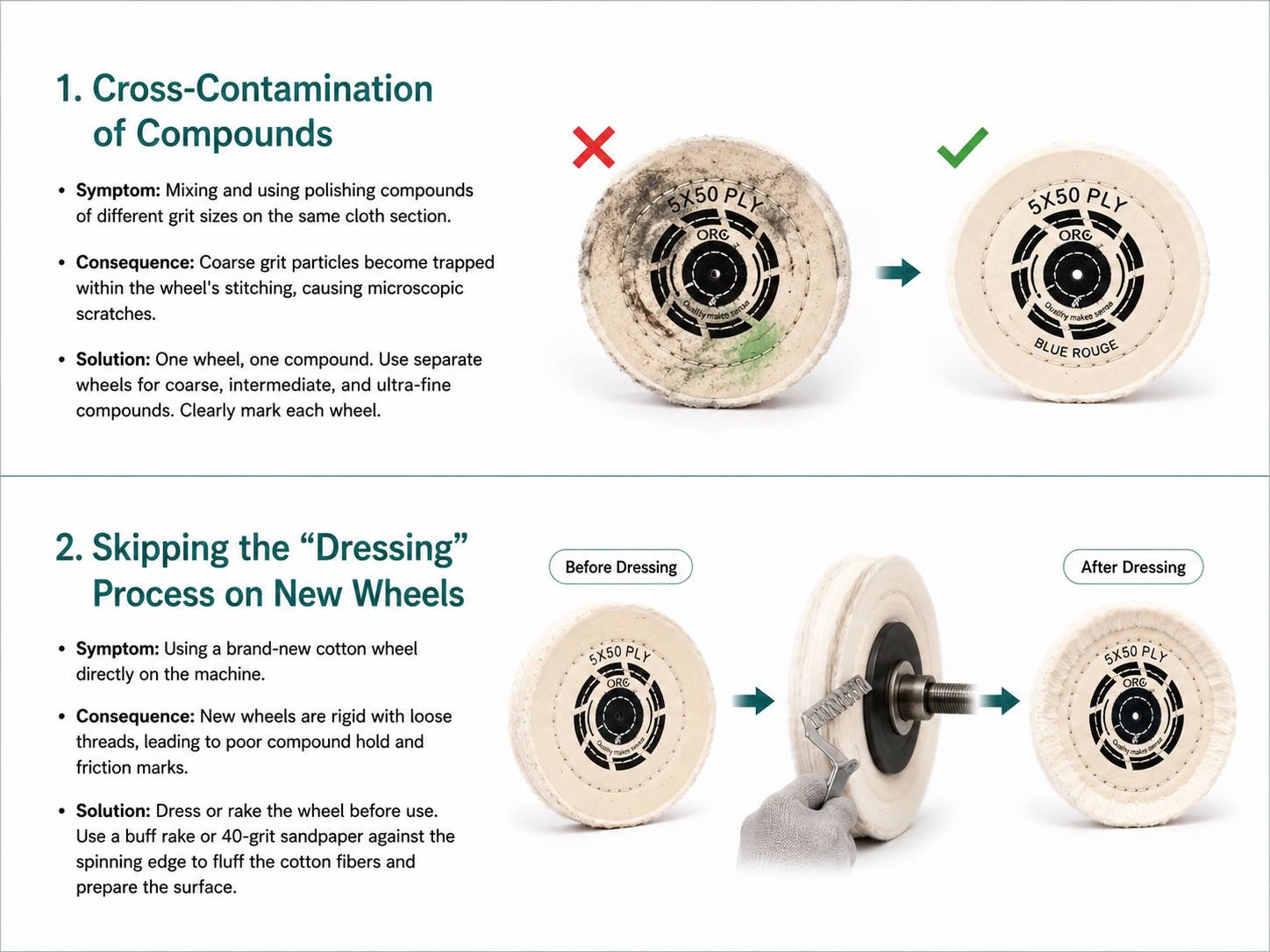
1. Cross-Contamination of Compounds
- Symptom: Mixing and using polishing compounds of different grit sizes on the same cloth section. For example, performing both heavy cutting and final coloring on a single wheel.
- Consequence: Coarse grit particles become trapped within the wheel's stitching. This directly compromises subsequent fine-polishing stages. It results in microscopic surface scratches that are impossible to remove without restarting the entire job.
- Solution: Remember the rule: one wheel, one compound. Strictly dedicate a specific piece of buffing equipment to each distinct type of abrasive compound. Use separate wheels for coarse Tripoli, intermediate green bars, or ultra-fine blue rouge. Clearly mark each wheel with permanent text labels or color-coded markers on the center hub.
2. Skipping the "Dressing" Process on New Wheels
- Symptom: Using a brand-new cotton wheel—fresh from the factory—directly on the machine spindle to apply compound and begin buffing.
- Consequence: New cloth wheels often have overly rigid, compressed edges and excessive loose threads. They fail to effectively hold the polishing compound. Instead of polishing, they are prone to leaving hard friction marks or uneven impressions on the workpiece surface.
- Solution: Prepare your tools first. After mounting a new wheel on the machine, you must dress or rake it. Turn on the machine and gently hold a specialized buffing rake or coarse 40-grit sandpaper against the spinning edge. This process fluffs up the cotton fibers. It makes the surface soft, pliable, and ready to accept the compound evenly.
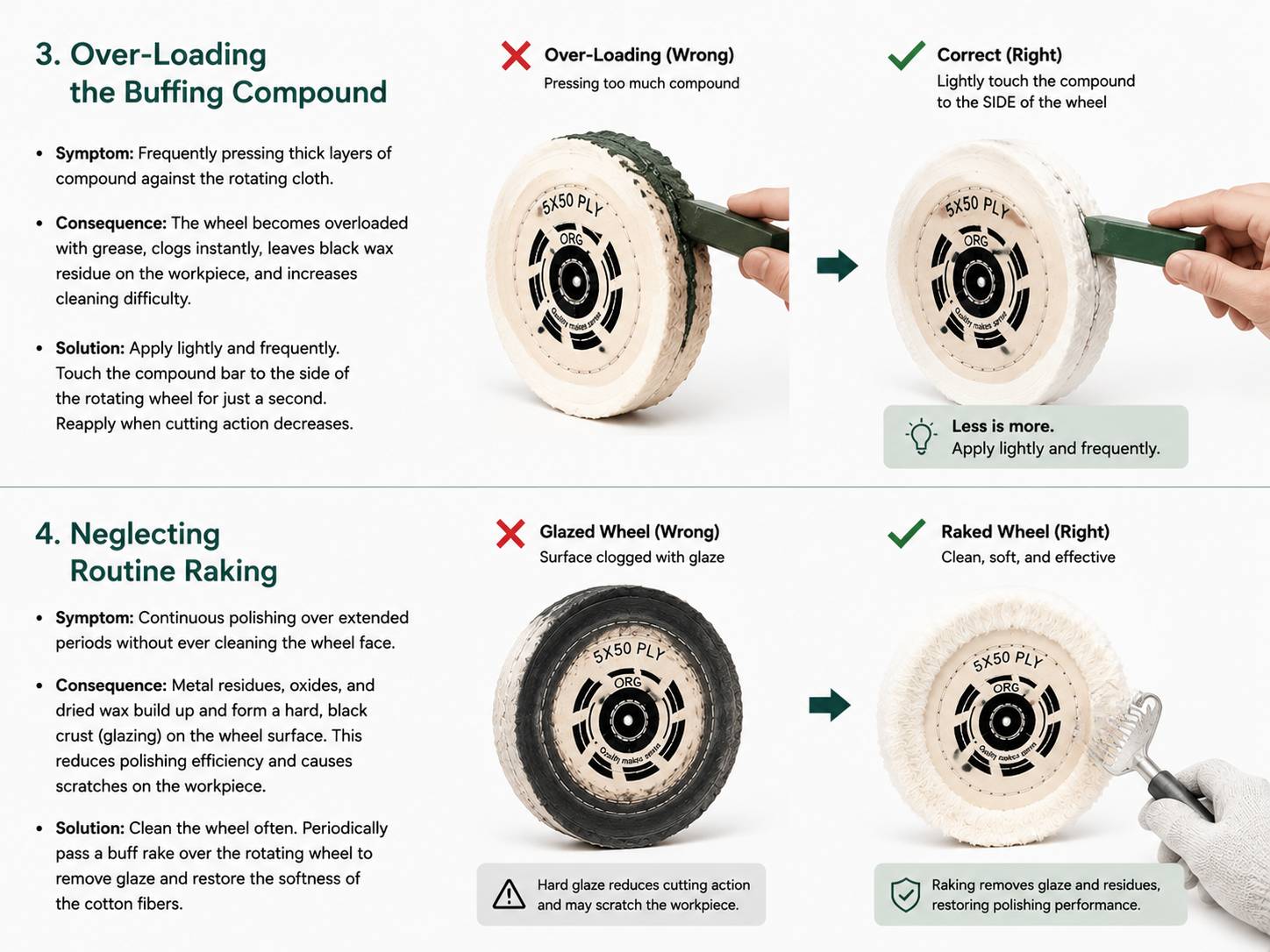
3. Over-Loading the Buffing Compound
- Symptom: Frequently pressing thick layers of compound against the rotating cloth, under the mistaken belief that more product equals faster results.
- Consequence: The buffing wheel becomes overloaded with heavy grease. Its surface clogs instantly. A significant amount of black wax residue remains on the workpiece surface. This obscures visibility during operation and drastically increases the difficulty of subsequent ultrasonic cleaning.
- Solution: Adhere to the principle of apply lightly and frequently. Less is more. Gently touch the compound bar against the spinning wheel for just a second. Work your piece. When you sense a decrease in cutting action, apply another micro-layer.
4. Neglecting Routine Raking
- Symptom: Continuous polishing over extended periods without ever cleaning the face of your finishing wheel.
- Consequence: Metal residues, oxides, and dried wax bind together. They form a hard, black crust known as glazing on the wheel surface. This crust loses its polishing efficacy. It hardens, turns abrasive, and begins to scratch the workpiece.
- Solution: Clean the wheel often. Periodically pass a buff rake over the rotating wheel during long production runs. This removes the glaze. It safely strips away hard surface residues and restores the natural softness of the cotton fibers.
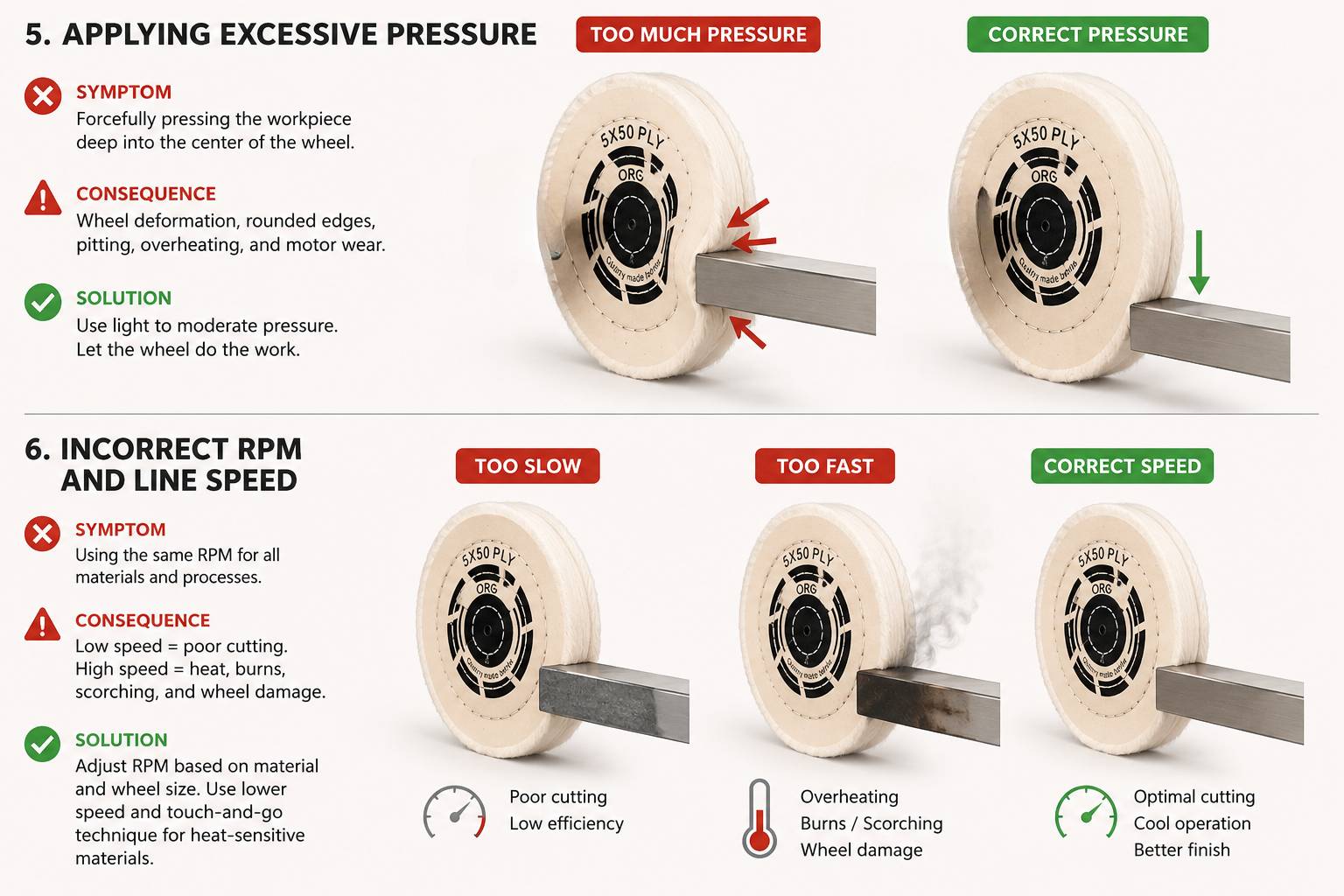
5. Applying Excessive Pressure
- Symptom: Forcefully pressing the workpiece deep into the center of the wheel to accelerate the polishing process through sheer physical strength.
- Consequence: True polishing occurs via the micro-abrasives sitting right at the tips of the spinning fibers. Excessive pressure causes the wheel to deform and lose its natural structural resilience. This leads to rounded edges on sharp designs, pitting, or permanent deformation of the workpiece. It also overheats and wears down the motor spindle.
- Solution: Let the tool do the work. Apply only light to moderate pressure. Utilize the high surface speed of the wheel to perform a clean micro-cutting action.
6. Incorrect RPM and Line Speed
- Symptom: Running the exact same rotational speed (RPM) for all workpiece materials and processing stages.
- Consequence: Low speeds cause insufficient cutting force, leading to terrible efficiency. High speeds generate severe frictional heat. This easily scorches heat-sensitive materials like low-melting-point dental resins or delicate gold alloys. It can even cause localized carbonization of the cotton fabric itself.
- Solution: Adjust your speed setting. Calculate RPM based on workpiece material and wheel diameter. When working with heat-sensitive materials, reduce the speed of your micro-motor or bench grinder. Employ a touch-and-go polishing technique. Use intermittent contact to keep temperatures low.
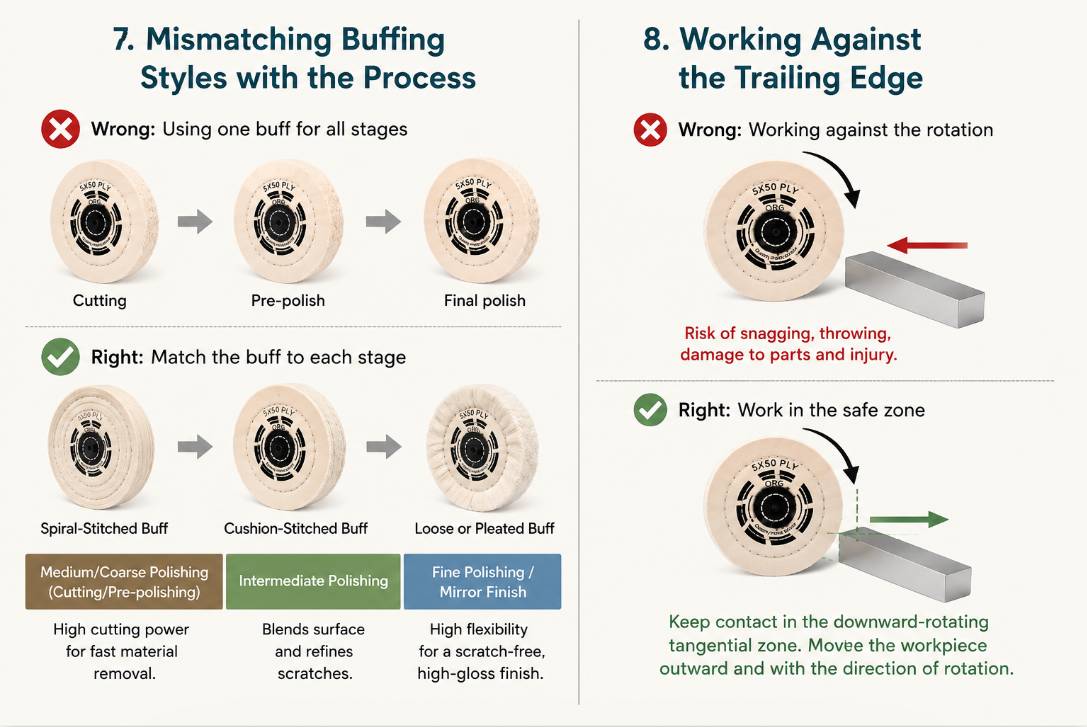
7. Mismatching Buffing Styles with the Process
- Symptom: Using a single type of cloth buff uniformly across all roughing and finishing stages.
- Consequence: Using a loose-stitched buff for heavy cutting yields extremely low efficiency. Conversely, using a rigid, tight spiral-stitched buff for a final mirror finish leaves hard surface track marks. It fails to produce a high-gloss, deep shine.
- Solution: Match the wheel construction to the specific process stage:
- Medium/Coarse Polishing (Cutting/Pre-polishing): Select Spiral-Stitched Buffs. They provide the necessary structural hardness and high cutting power.
- Fine Polishing/Mirror Finish (Coloring/Final Finish): Select Loose Buffs or Pleated Buffs. Utilize their high flexibility to achieve a scratch-free, high-gloss finish.
8. Working Against the Trailing Edge
- Symptom: Feeding a sharp edge or corner of the workpiece directly against the direction of the wheel rotation.
- Consequence: The workpiece can be instantly caught, snagged, and violently thrown by the rapidly rotating buff. This results in ruined parts, broken equipment, and severe personal injury.
- Solution: Stay in the safe zone. The workpiece should always make contact within the downward-rotating tangential zone of the wheel. When polishing objects with sharp edges, prongs, or holes, ensure the movement is a smooth dragging motion directed outward and along the direction of rotation.
II. Summary Chart: Matching the Right Buff & Compound
To maximize the efficiency of your cotton buffing wheels, use this quick selection reference chart for your workshop:| Polishing Stage | Recommended Buff Style | Surface Density | Typical Abrasive Compound | Target Outcome |
| Coarse Cutting | Spiral-Stitched Cotton | High / Rigid | Black Tripoli / Emery Paste | Removes scratches, scale, and casting lines. |
| Intermediate Cut | Cushion-Stitched Cotton | Medium | White Diamond Compound | Blends surfaces and prepares metal for shine. |
| Final Coloring | Loose Open Cotton | Soft / Flexible | Green Rouge / Blue Composition | Eliminates haze; creates a deep mirror finish. |
| Ultra-Fine Polish | Cotton Flannel / Pleated | Ultra-Soft | Red Rouge (Precious Metals) | Produces ultimate high-gloss reflectivity. |
Conclusion
Avoiding these 8 common mistakes will ensure your products achieve a flawless mirror finish. It will also extend the service life of your cotton buffing wheels and polishing machines. Protect your investment through proper technique.Are you looking for high-quality, durable, industrial-grade pure cotton polishing buffs? Browse Orobrush’s full product range, or contact our technical experts to inquire about bulk purchasing discounts today.