

Industry News
Clean Hard-to-Reach Recesses Using Flexible Radial Bristle Discs
Finishing intricate parts often comes down to a tough trade-off: leaving burrs inside deep crevices or accidentally ruining crisp edges with rigid tools. Flexible radial bristle discs solve this directly—their abrasive-impregnated polymer bristles flow into tight channels, carved recesses, and internal radii to clean and polish without altering precise geometries.
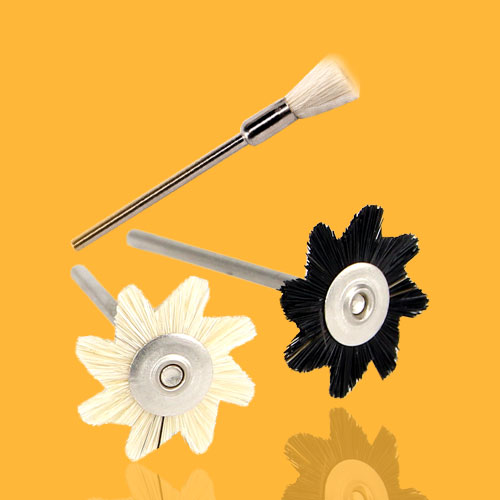
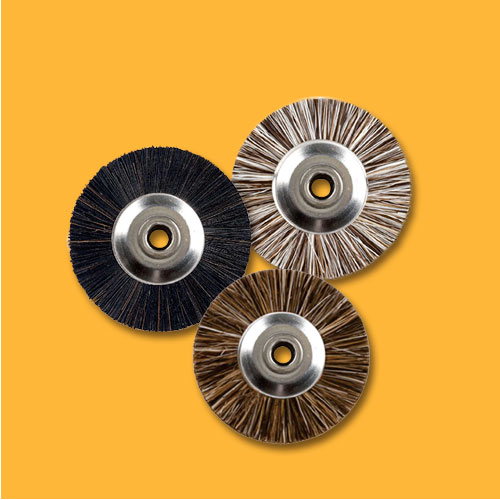
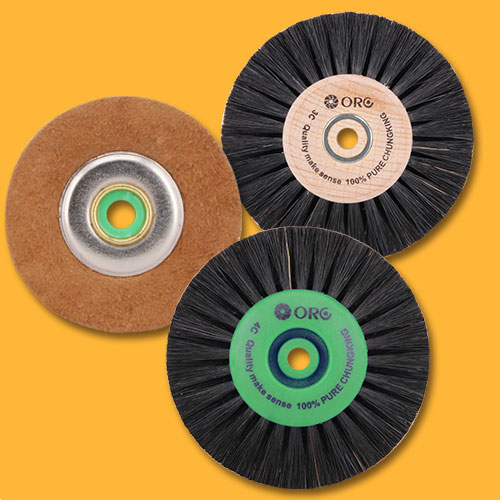
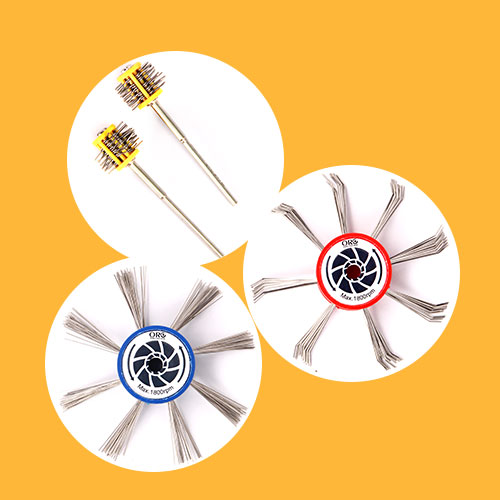
As a dedicated Radial Bristle Discs manufacturer and supplier, Orobrush produces a complete lineup of high-performance radial bristle discs designed for precision finishing in challenging geometries. Our product line features full grit spectrum coverage—from aggressive 80# coarseness down to ultra-fine 5000# polishing grains.
I.Why Flexible Radial Bristle Discs Work Best for Recesse
Whether you are clearing heavy investment casting scale from a detailed bronze sculpture or deburring machined cross-holes in aluminum, flexible bristle wheels provide advantages that rigid abrasives cannot match.- Conformability: The individual molded fingers flex independently, flexing around complex internal curves and reaching into narrow gaps that solid grinding pins or flat disc pads cannot touch.
- Preserves Geometry: Only the abrasive tips of the bristles make contact with the work surface. This localized action strips away surface oxidation, scale, and burrs while preserving delicate sharp corners, fine engraving, and precise engineering tolerances.
- Consistent Cutting Action (Self-Sharpening): Unlike coated abrasive paper that loads up and dulls rapidly, these polymer discs feature mineral grains distributed evenly throughout each bristle. As the tips wear down during rotation, fresh abrasive is constantly exposed, providing a uniform cut rate throughout the life of the tool.
II. Choosing the Right Grit, Size & Configuration for Your Recesses
Achieving an optimal finish in narrow channels requires matching the disc's abrasive density, diameter, and stack thickness to the geometry of your workpiece.
Grit & Color Selection
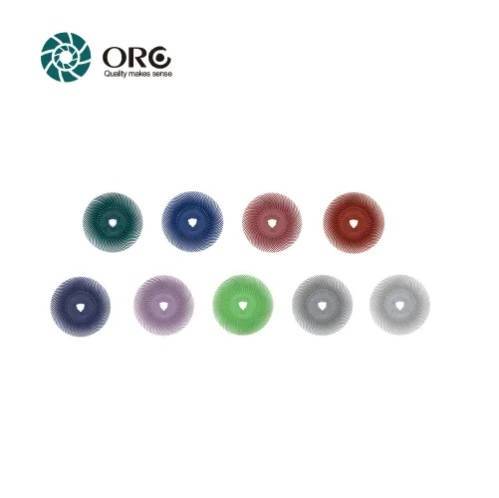
- Coarse (80# – 120# | Dark Green / Dark Blue): Formulated for heavy cleaning, aggressive stock removal, stripping thick oxide layers, and knocking down tough burrs inside cast or machined recesses.
- Medium (220# – 400# | Red / Brown / Blue): Ideal for removing fine machine lines, blending surface irregularities, light deburring, and smoothing tight internal radii after initial shaping.
- Fine / Polishing (600# – 5000# | Purple / Light Green / Grey / White): Designed for precision detail work, pre-polishing, semi-finishing, and achieving a high-luster or mirror-like polish inside narrow slots on precious metals, titanium, and stainless steel.
Dimensions & Stacking Configuration
Select your wheel diameter based on the accessibility of the recess:- Standard Diameters: Available in Φ19mm (3/4"), Φ25mm (1"), Φ50mm (2"), and Φ75mm (3") to fit different handpiece attachments and bench grinders.
- Single vs. Stacked Discs: Use 1 to 2 discs mounted together when working in extremely narrow grooves. For wider slots, internal steps, or broader recessed areas, stack 3 to 6 radial bristle discs on a single screw mandrel to create a wider, continuous brush face.
III. Step-by-Step Guide to Cleaning Hard-to-Reach Recesses
Cleaning and finishing complex internal geometries requires more than just running a rotating tool back and forth. Following a disciplined, technique-driven workflow ensures thorough clearing of dead angles while preventing premature wear on the bristle assembly.
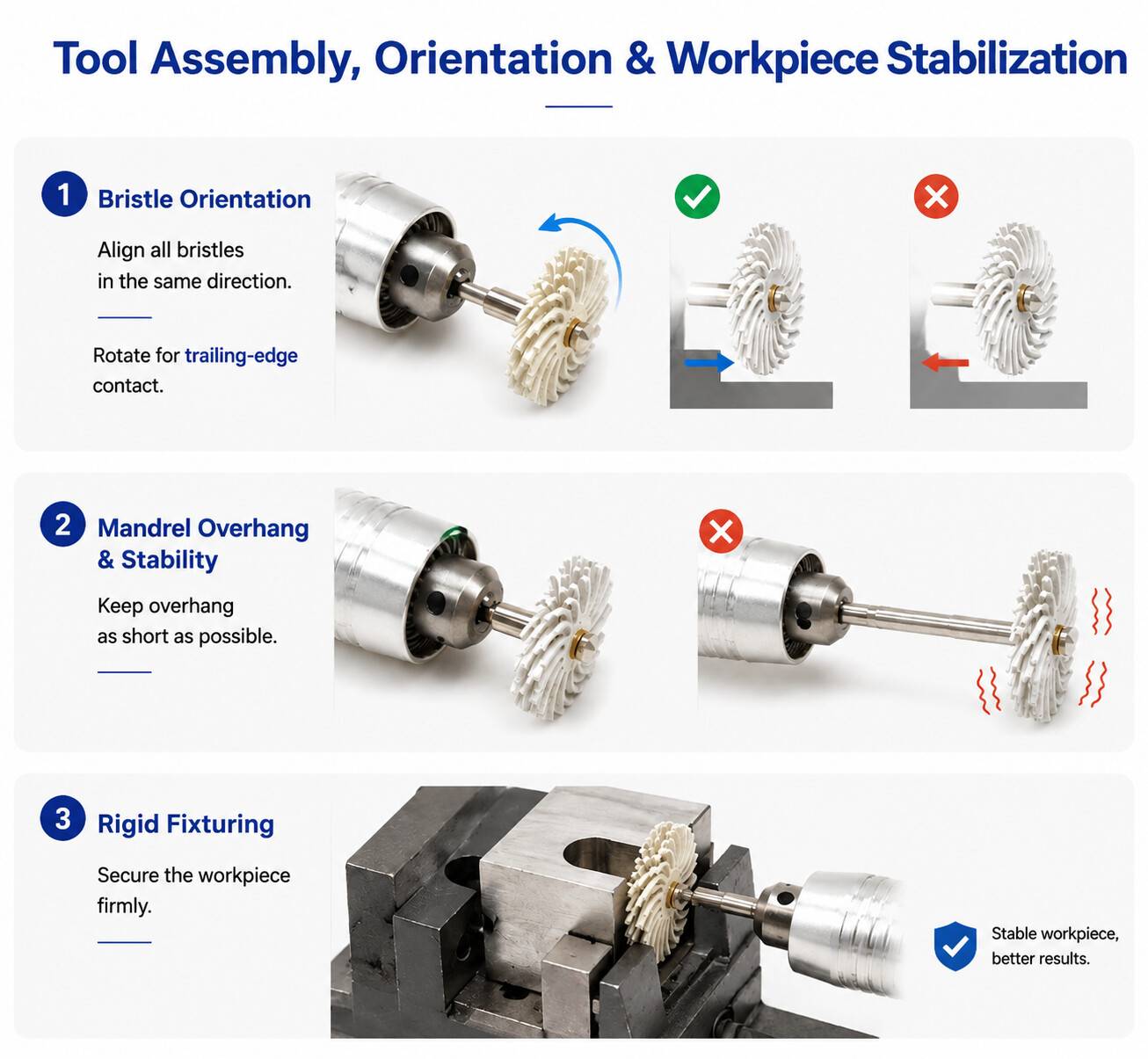
1. Tool Assembly, Orientation & Workpiece Stabilization
- Bristle Curve Orientation: When mounting multiple discs onto your screw mandrel, ensure the angled sweep of all molded bristles points in the exact same direction. Align the mandrel in your handpiece so that the rotation of the spindle pushes the bristle tips smoothly into the workpiece (trailing-edge contact) rather than jamming the bristles backward.
- Mandrel Overhang & Stability: Keep the mandrel overhang as short as possible within the handpiece collet to minimize shaft deflection and chatter when entering deep slots.
- Rigid Fixturing: Secure the workpiece using padded vise jaws, custom fixture blocks, or vacuum clamps. A moving workpiece introduces erratic tool bounces, which can snap bristle tips or mar neighboring surfaces.
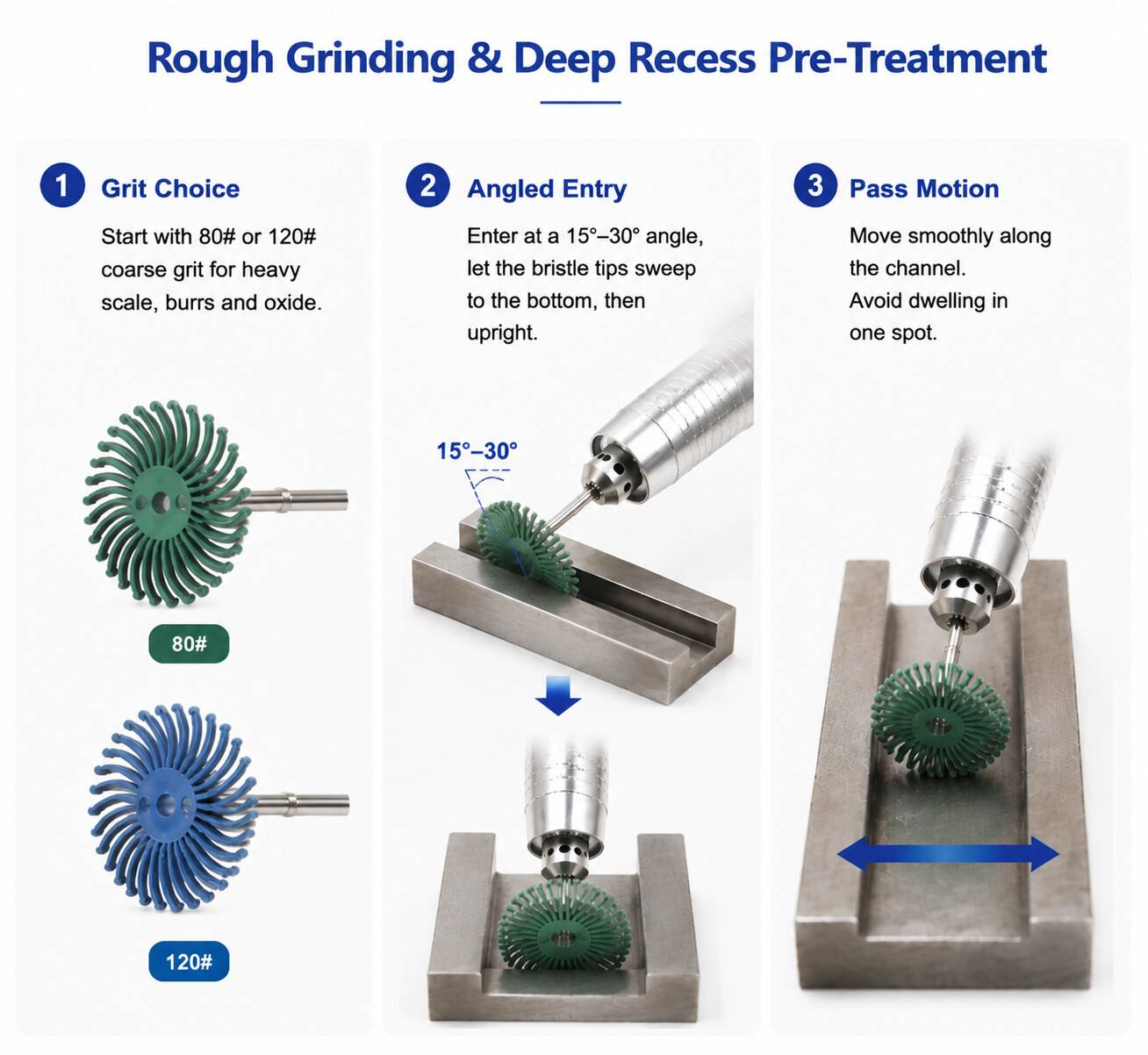
2. Rough Grinding & Deep Recess Pre-Treatment
- Grit Choice: Begin with an 80# or 120# coarse-grit radial bristle disc stack to tackle heavy casting scale, machining burrs, or thick oxide layers at the root of the groove.
- Angled Entry Technique: Do not drop the rotating disc straight down into a deep recess. Approach narrow slots at a slight 15° to 30° angle, allowing the flexible tips to sweep into the bottom radius before bringing the handpiece perpendicular to the channel walls.
- Pass Motion: Move the spinning assembly along the channel with smooth, continuous stroke rates. Avoid dwelling in a single location to prevent heat buildup on delicate internal radii.
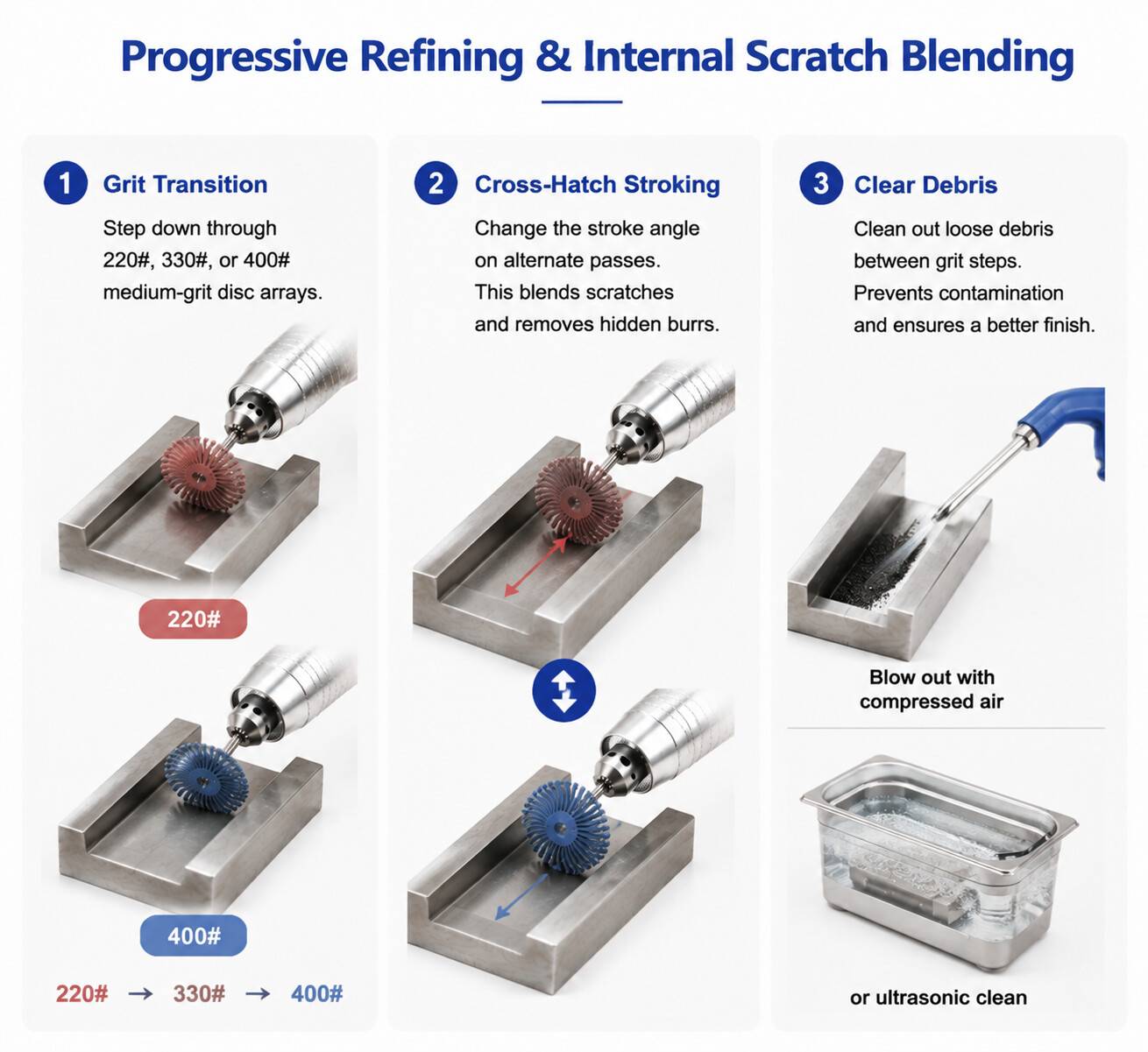
3. Progressive Refining & Internal Scratch Blending
- Grit Transition Strategy: Step down through 220#, 330#, or 400# medium-grit disc arrays to replace the aggressive scratch pattern of the coarse step.
- Cross-Hatch Stroking: Where slot access permits, alter your feed stroke angle slightly on alternate passes. Sweeping across the previous scratch lines speeds up stock leveling and ensures burrs hidden in sidewall undercut grooves are completely sheared off.
- Clearing Packed Debris: Pause between grit steps to blow out loose abrasive dust and metal swarf from deep cavities using clean compressed air or an ultrasonic bath. Trapped coarse grains can contaminate subsequent finer steps.
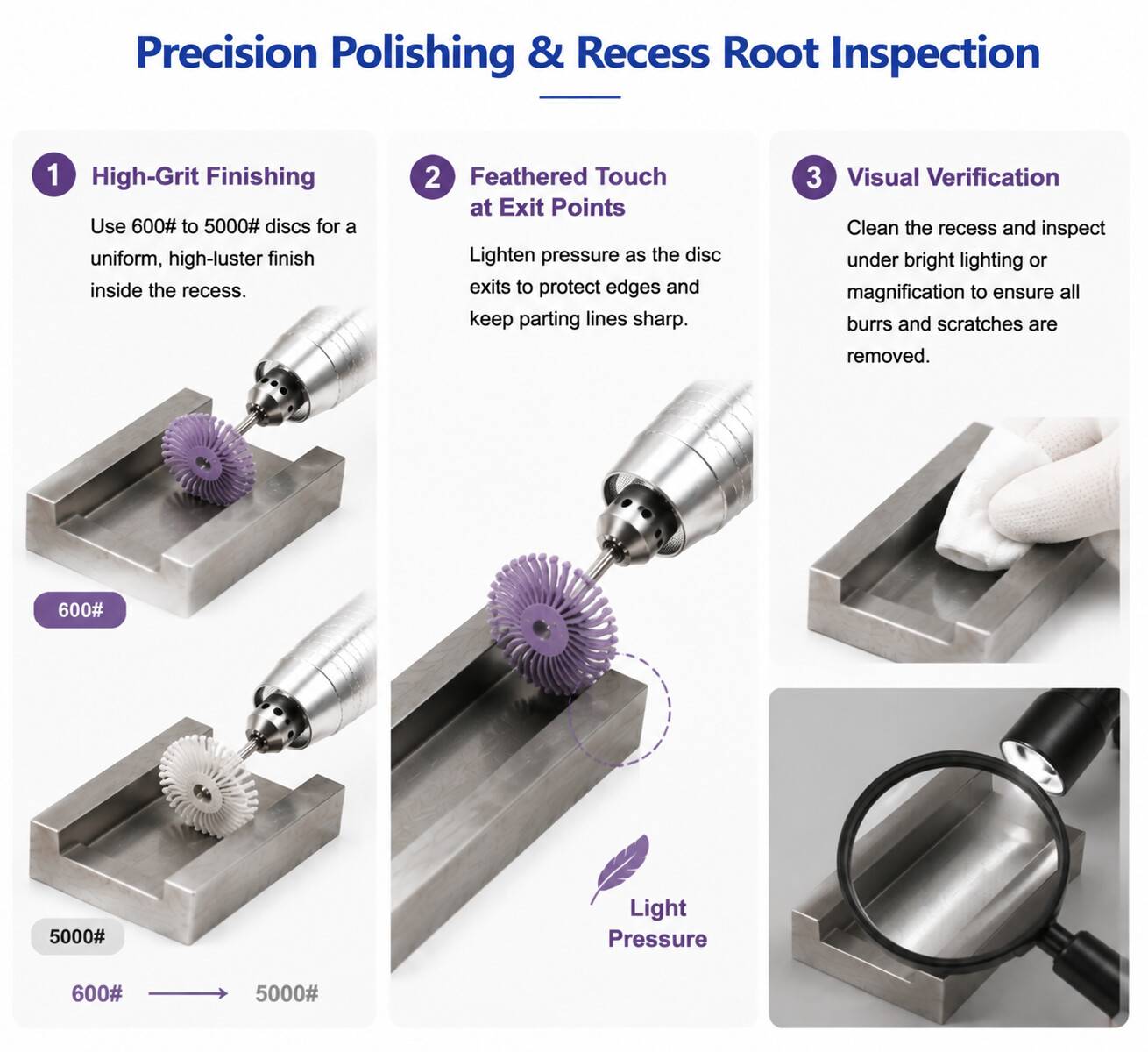
4. Precision Polishing & Recess Root Inspection
- High-Grit Finishing: Mount a 600# to 5000# fine-grit disc stack to develop a uniform satin, semi-finish, or high-luster mirror finish throughout the inner channel.
- Feathered Touch at Exit Points: As the disc exits open-ended slots or intersecting blind holes, lighten hand pressure even further to prevent the flexible bristles from whipping around external exit edges and rounding off crisp parting lines.
- Visual Verification: Clean the internal cavity completely with a lint-free cloth or solvent wipe. Inspect the root of the recess under bright, angled spot lighting or optical magnification to verify that all stress risers, micro-burrs, and deep scratches have been eliminated.
IV. Essential Operational Tips for Maximum Efficiency & Tool Life
Working with radial bristle tools requires a slightly different technique than working with standard grinding wheels or mounted points.Light Pressure, Optimal RPM
The most common mistake when using bristle discs is applying heavy downward pressure. Forcing the tool against the work causes the bristles to bend flat against the core, generating excessive friction heat that can melt the polymer matrix and smear the workpiece. Let the tips do the work. Light contact allows the abrasive points to strike the surface at high speed, maximizing cutting action while preserving bristle geometry.Speed Control & Safety
- Optimal & Maximum RPM: Operate small detail discs (Φ19mm and Φ25mm) efficiently between 15,000 and 20,000 RPM. Never exceed the maximum safe operating speed of 30,000 RPM.
- Safety Gear: Always wear impact-resistant safety glasses or a face shield, alongside a fitted dust mask or local exhaust ventilation to protect against fine airborne particulate matter.
Sourcing Premium Radial Bristle Discs for Workshops & Industrial Use
For precision manufacturing, jewelry production, and industrial maintenance, having access to consistent, high-grade abrasive tools is essential for maintaining production standards.As a dedicated Radial Bristle Discs manufacturer and supplier, Orobrush produces a complete lineup of high-performance radial bristle discs designed for precision finishing in challenging geometries. Our product line features full grit spectrum coverage—from aggressive 80# coarseness down to ultra-fine 5000# polishing grains.
- Bulk Purchasing Support: We provide custom multi-grit boxed assortments and high-volume wholesale packaging options tailored for production facilities, commercial workshops, and tool distributors.
- Inquiries & Custom Ordering: Contact the Orobrush technical team today to request detailed product specifications, order trial samples, or discuss volume pricing structures for your operation.