

Industry News
How to Pick the Best Polishing Brush for Your Rings
Polishing is a precision science that reveals metal’s refractive properties while protecting surfaces from oxidation. The polishing brush serves as the essential interface between machine torque and delicate jewelry geometry. Selecting the right technical tool is the only path to a professional, "black-light" mirror finish.
The Ironclad Law: Hard brushes carry coarse grits; soft brushes carry fine silicas.
A technical pitfall many face is cross-contamination. Never use multiple compounds on a single polishing brush. Even one particle of coarse Tripoli on a finishing goat-hair brush will create "ghost lines." This prevents a true mirror finish. Always label your brushes by compound type.
Precision matters in every revolution. Visit the Orobrush official website to browse our technical range of jewelry finishing tools. Whether you need a single pen brush for a custom piece or B2B bulk supply for a manufacturing line, we provide the industrial consistency you demand. Reach out to our technical team today for a wholesale quote.
I. Selecting Bristle Materials
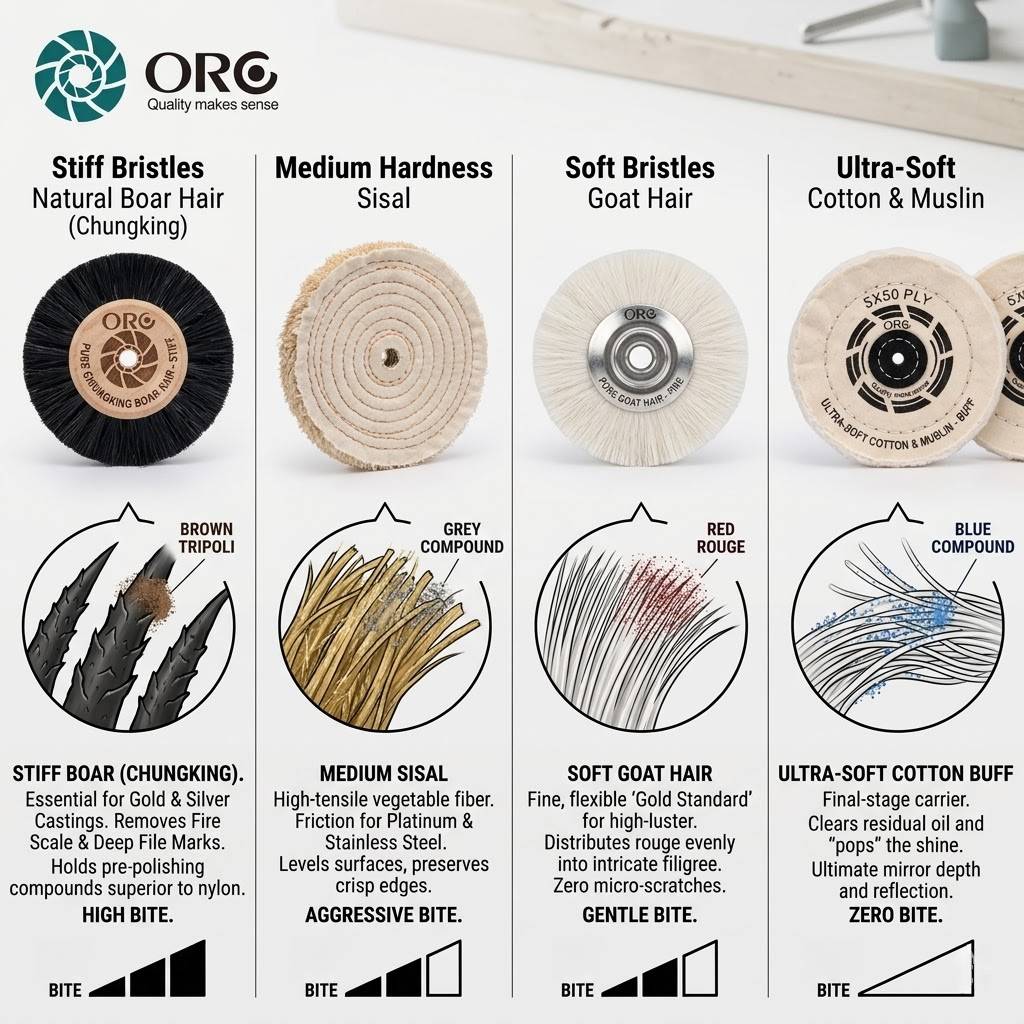
The material determines the "bite"—the aggressive or gentle removal of surface layers.
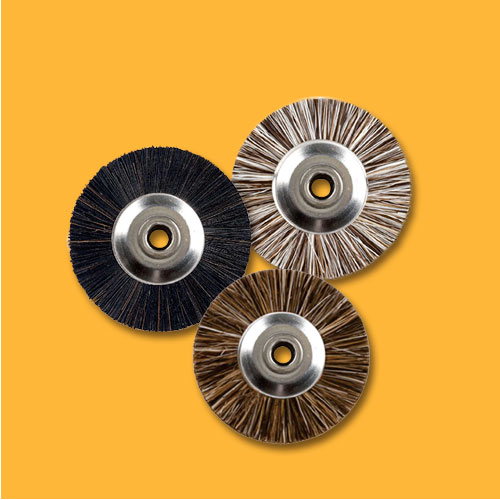
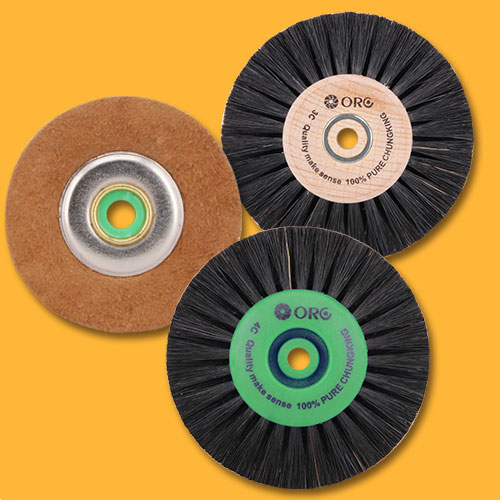
- Stiff Bristles / Natural Boar Hair (Chungking): These fibers have natural scales. This texture holds Tripoli and other pre-polishing compounds better than synthetic nylon. They are indispensable for removing fire scale and deep file marks from gold or silver castings.
- Medium Hardness / Sisal: Sisal is a high-tensile vegetable fiber. When paired with aggressive grey compounds, it generates the friction needed for platinum or stainless steel. It excels at leveling surfaces without rounding off crisp edges.
- Soft Bristles / Goat Hair: This is the industry gold standard. The hairs are incredibly fine and flexible. They distribute fine rouge evenly into intricate filigree. Use this to achieve a high-luster finish without leaving directional micro-scratches.
- Ultra-Soft / Cotton & Muslin: These are final-stage carriers. Their goal is to clear residual oil and "pop" the shine. They provide the ultimate depth in the metal’s reflection.
II. Selecting Brush Shapes Based on Ring Geometry
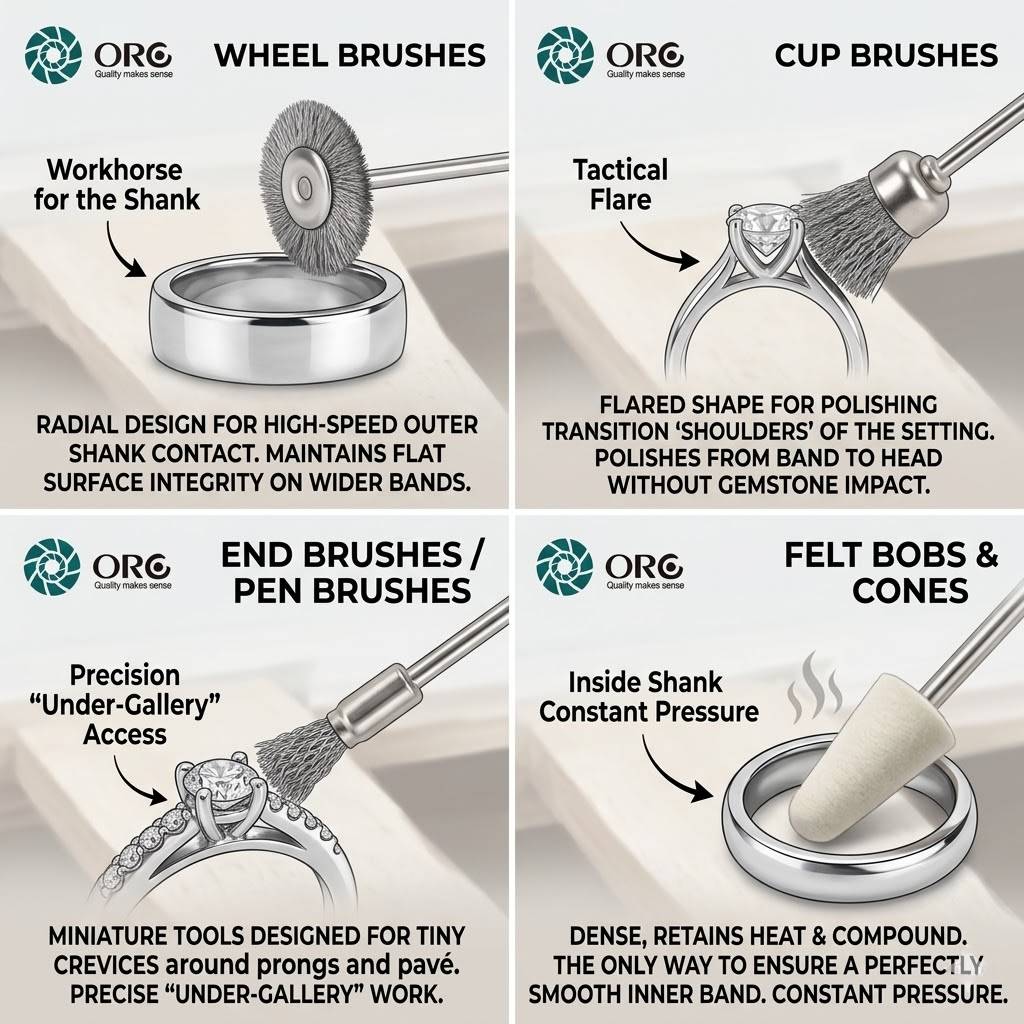
A ring is a collection of curves, angles, and tight gaps. One tool cannot reach them all.
Wheel Brushes
These are workhorses for the shank. Their radial design allows for high-speed contact on the outer circumference. They maintain flat surface integrity on wider bands.Cup Brushes
The flared shape is tactical. Use cup brushes for the "shoulders" of the setting. They allow you to polish the transition from the band to the head without hitting the gemstone.End Brushes / Pen Brushes
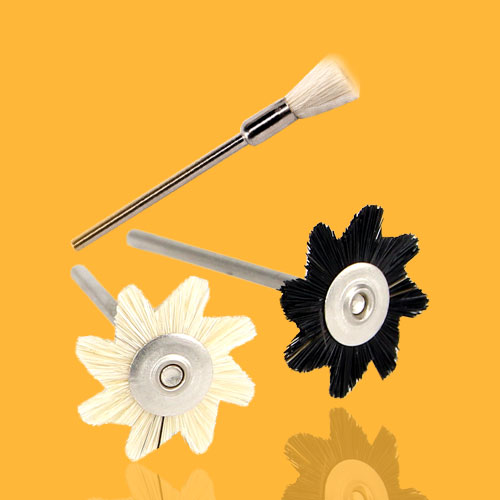
Precision is mandatory here. These miniature tools are designed for "under-gallery" work. They access the tiny crevices around prongs and pavé-set diamonds where light often gets trapped by dirt.Felt Bobs & Cones
The inside shank requires constant pressure. Felt bobs are dense. They retain heat and compound better than loose bristles. This is the only way to ensure the inner band is as smooth as the outer surface.III. Compatibility Between Brushes and Polishing Compounds
The density of the brush bristles determines its "loading capacity."The Ironclad Law: Hard brushes carry coarse grits; soft brushes carry fine silicas.
A technical pitfall many face is cross-contamination. Never use multiple compounds on a single polishing brush. Even one particle of coarse Tripoli on a finishing goat-hair brush will create "ghost lines." This prevents a true mirror finish. Always label your brushes by compound type.
IV. Professional Operating Parameters
The RPM Sweet Spot
Rotational speed dictates the "cutting" power. For precision ring work, aim for 8,000 – 15,000 RPM.- Too slow: The brush "drags" and creates an uneven surface.
- Too fast: The centrifugal force flattens the bristles, reducing efficiency and causing shedding.
Pressure and Thermal Management
Use a light touch. Let the tips do the work. Excessive pressure creates friction-generated heat. In gold alloys, this heat can "smear" the metal, ruining the crispness of the design.The Professional Break-In
New brushes shed. Before touching a ring, run the new brush against a clean scrap of hardwood for 30 seconds. This seats the bristles and removes loose fibers.V. B2B Purchasing Guide: How to Assess Brush Quality
When sourcing at scale, look for these technical markers:- Concentricity: High-grade brushes have perfectly centered shanks (2.35mm). A vibrating brush ruins the finish and destroys your micromotor bearings.
- Tuft Density: Check the center hub. A dense tuft count means the brush won't "flare out" under load. This extends tool life by 40%.
- Shank Material: Stainless steel shanks offer better corrosion resistance than cheap plated alloys. This is vital in humid workshop environments.
Technical Comparison Table
| Polishing Phase | Brush Material | Recommended Compound | Result Goal |
| Heavy Pre-treatment | Stiff Boar / Sisal | Brown (Tripoli) | Removing scale & pits. |
| Intermediate Prep | Horsehair / Med Boar | White / Grey | Eliminating scratches. |
| Fine Finishing | Soft Goat Hair | Red Rouge | Preliminary mirror shine. |
| Super-Mirror Pop | Cotton / Chamois | Blue (Luxi/Blue) | Zero-streak "Black" luster. |
Conclusion
The best polish starts with the best choice of fiber. By matching your polishing brush to the specific metal hardness and ring geometry, you eliminate rework and maximize brilliance.Precision matters in every revolution. Visit the Orobrush official website to browse our technical range of jewelry finishing tools. Whether you need a single pen brush for a custom piece or B2B bulk supply for a manufacturing line, we provide the industrial consistency you demand. Reach out to our technical team today for a wholesale quote.